Give families firsthand context
A company can describe its service area and arrangements. An eligible reviewer can describe their own experience, without being prompted to reveal a diagnosis, route, facility, or someone else’s private information.
Choosing transportation can involve a passenger, a family member, and several practical questions. Invite an appropriate recipient to share an honest service experience, with privacy and permissions considered before the campaign starts.
$1,000 setup plus $900 for a standard 60-day campaign. Setup, sending and the first wave are done by us. Your customer’s own words, on your own domain.
A person arranging non-emergency transportation may want to understand the service experience before making contact. Firsthand reviews can provide context about what a customer experienced. They do not establish clinical quality, replace service verification, or prove that an operator meets a particular regulatory standard.
A company can describe its service area and arrangements. An eligible reviewer can describe their own experience, without being prompted to reveal a diagnosis, route, facility, or someone else’s private information.
The person who booked, paid, accompanied, and received the ride may not be the same person. Decide who can appropriately be contacted and what they can genuinely speak about before making a list.
An approved message and a named owner make the process easier to review. The campaign should not depend on a driver requesting a rating during transport or tying assistance to participation.
Operational data may contain far more detail than a review request needs. Before anything is imported, confirm the authority to use the information, the recipient, the allowed purpose, and the minimum fields. The right first step is a data-flow assessment, not a bulk upload.
A useful campaign starts with a real audience and a specific operational problem. These are situations to explore, not a promise that every business needs a campaign.
A public reputation may support their research. Start with an eligible, appropriately authorized group and one listing.
Determine whether the family member has a genuine experience to describe and whether contacting them is appropriate. Do not assume booking on another person’s behalf grants every permission.
Reviews may be supporting context, but this offer does not promise broker contracts, facility referrals, credentialing, or reimbursement outcomes.
We configure and launch the workflow. Your customer controls the review.
Review the actual data flow, applicable obligations, permissions, and any needed processor agreements before importing records. If requirements cannot be met, do not launch.
Do not include diagnoses, insurance details, treatment schedules, pickup/drop-off addresses, or appointment locations in draft context. Minimized data can still be sensitive.
Use an approved channel and a voluntary request. Never ask a person to review while dependent on assistance, and do not offer a benefit for posting.
Restrict access to authorized staff and separate listing changes from individual outreach activity. A public reply must not reveal private information just because the reviewer posted first.
The draft is a starting point built from the facts of the customer’s own visit, not a submission. The customer rewrites it, asks for another wording, or replaces it entirely before publishing from their own account. Nothing is posted from this page, and the rating is chosen on the review site under the customer’s own account.
Whether HIPAA or other obligations apply depends on the operator, its role, contracts, and the data being processed. The standard commercial price applies only if the approved workflow can be delivered within scope. Required agreements, controls, or a different architecture must be confirmed before purchase.
The standard launch starts with one usable export. It does not assume a new CRM integration or a fully automatic service trigger.
The published product page lists Swift Care and AVI Transportation as being in preparation, with no results to report. We do not present the martial arts case as proof of transportation performance. Start by checking operational and privacy fit, then measure one appropriate campaign.
The first campaign should establish:
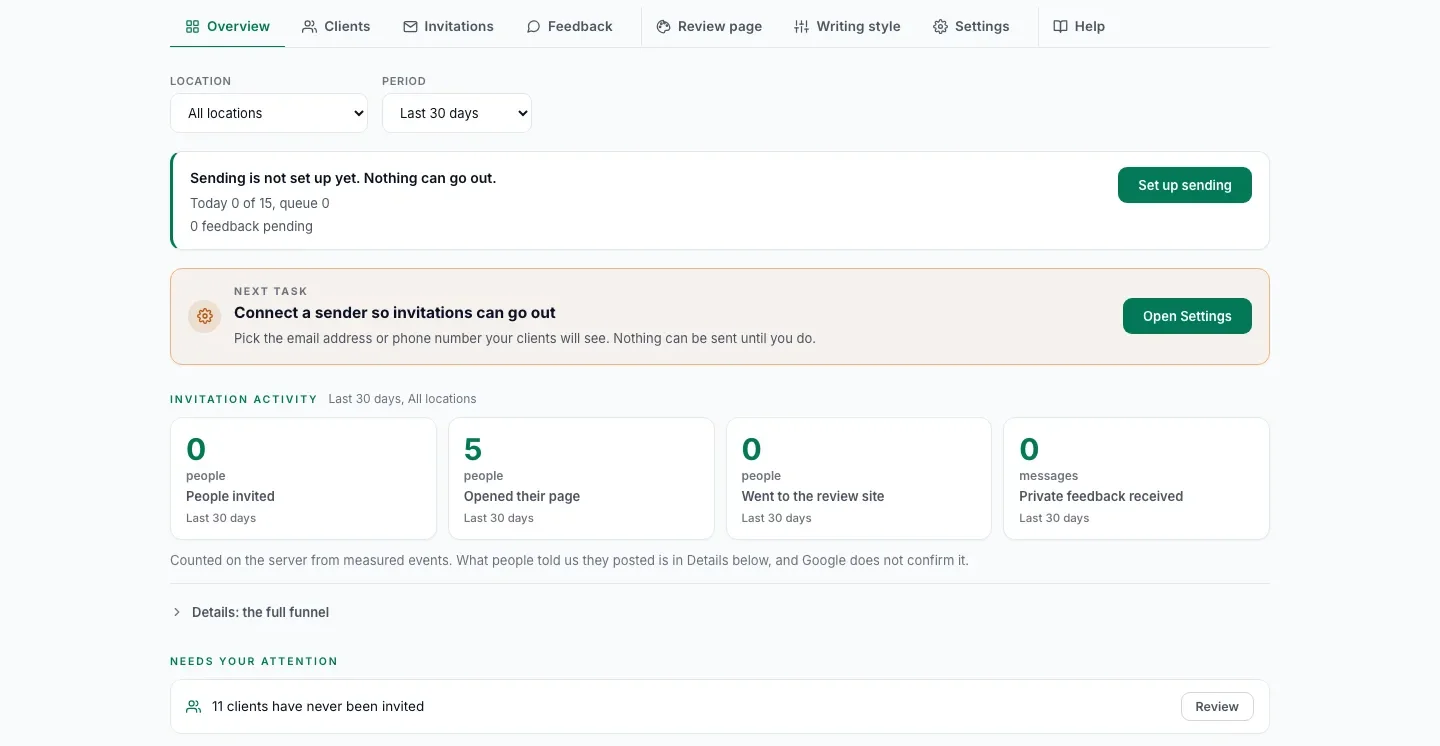
A dashboard should help you decide what to do next. It should not turn a click into a published review or a change in the listing into a promise about revenue.
Who entered the campaign and which sends succeeded or failed.
Customer-page engagement, copying, and clicks to the review platform.
What customers tell us they posted. This is not verified publication.
Dated public counts and ratings. For the managed campaign, this dated public count is what the final report shows. Organic activity can affect it too.
Each customer on your list has one invitation status, with the same words for email, SMS and WhatsApp. A status your staff set by hand is labelled as a staff mark.
| Not invited | No invitation has gone out yet. |
|---|---|
| Scheduled | It goes out on its own at a set time. Nothing to do. |
| Ready to send | Waiting for your staff to send it by hand from their own WhatsApp or phone. |
| Sent | The message went out, as the provider reports or your staff mark it. |
| Delivered | The phone received it, as the SMS or WhatsApp provider reports or your staff mark it when they see it delivered, such as two grey ticks in WhatsApp. Emails stay at Sent. |
| Failed | It did not go out, or it bounced, as the provider reports or your staff mark it with a reason, such as a wrong number or a number not on WhatsApp. |
| Cancelled | It is not going to be sent. |
Progress then follows each customer from opening their page to writing a draft, copying it, clicking through to Google and saying they posted, and that last step is their own word, because Google does not tell anyone who published.
Review counts, ratings, rankings and new customers are not guaranteed. Google controls publication and moderation. A rise in the public count can be observed during a campaign without proving the campaign caused it.
The standard campaign is one brand, one Google location, the customers you already served with no cap per location, one English email campaign, and 60 days. For transportation, data-flow approval and any required safeguards come first.
| Duration | 60 days from launch |
|---|---|
| Scope | One brand, one Google location |
| List | The customers you already served and may contact. No cap per location |
| Channel | Email in English |
| Destination | |
| Included | List preparation, sender and domain setup, invitation copy, first wave launched by us, monitoring, final report |
| You provide | The list, DNS and Google Business Profile access, message approval, someone to answer private feedback |
| Extra locations | $900 each in the same campaign |
| Quoted separately | Languages, WhatsApp or SMS, integrations, custom data work |
Non-standard requirements such as integrations, additional languages or custom data work are quoted separately and can raise the price substantially.
We run the campaign for you
$1,000 setup plus $900 for a standard 60-day campaign
A defined campaign at a fixed price, with no guaranteed review volume and no automatic renewal.
Run it yourself
$1,000 setup plus $179 per location per month
We set it up, launch the first wave and train your team. Your team sends the next waves from the dashboard.
Pay yearly and save 15% on monthly fees. There is no cap on customers per location. More than 5 locations and more than 3,000 customers: we plan the project with you on a call.
The setup is yours to keep in either option: your domain, your sending, your list prepared, and the first wave launched. It is paid once and is not credited against other fees. The campaign fee is fixed and does not depend on the number of reviews. There is no automatic renewal.
The setup includes a review audit of your Google listing: a dated report of where it stands before the first invitation. See a sample report.
The final report compares the listing’s public review count on the launch date and on day 60, both counts recorded with dated screenshots. It shows what the listing gained over the period, not a claim that each review was caused by the campaign, and the price does not depend on it. Clicks, copied text and self-reported posts are reported separately and never presented as published reviews.
After the campaign, we can keep inviting your new customers for $549 per location per month, with a monthly report, or $459 with 5 or more locations. On the Self-Run Plan, $179 per location per month covers hosting, sending and drafts for the standard scope, and your team runs the waves. Both are month to month. Source code is not included.
Prices in USD, taxes additional. Offer details are confirmed in the order.
Worth saying plainly, because the wrong starting point wastes a campaign for both of us.
Start with the actual workflow and scope, not an assumed result.
Bring one Google listing and a rough count of passengers or families you may contact. On a 30-minute call we say whether the standard campaign fits and record the starting count with you. Do not attach passenger records, health information, or transport details.
Check whether your list is a fit
Prefer email to a call? Check your Google listing and ask for a plan.
Calendar not opening? Open it in a new tab or write to we@fractalic.studio.
An initial conversation, not a commitment to buy. Please do not send customer lists or sensitive records.
Further reading: HHS guidance illustrated by an online-review privacy enforcement case. Published Review Machine case and product context. Scope and requirements are confirmed for your business before purchase.